ওহমের সূত্র (V = I × R) আর voltage dividerOhm's Law (V = I × R) & Voltage Divider
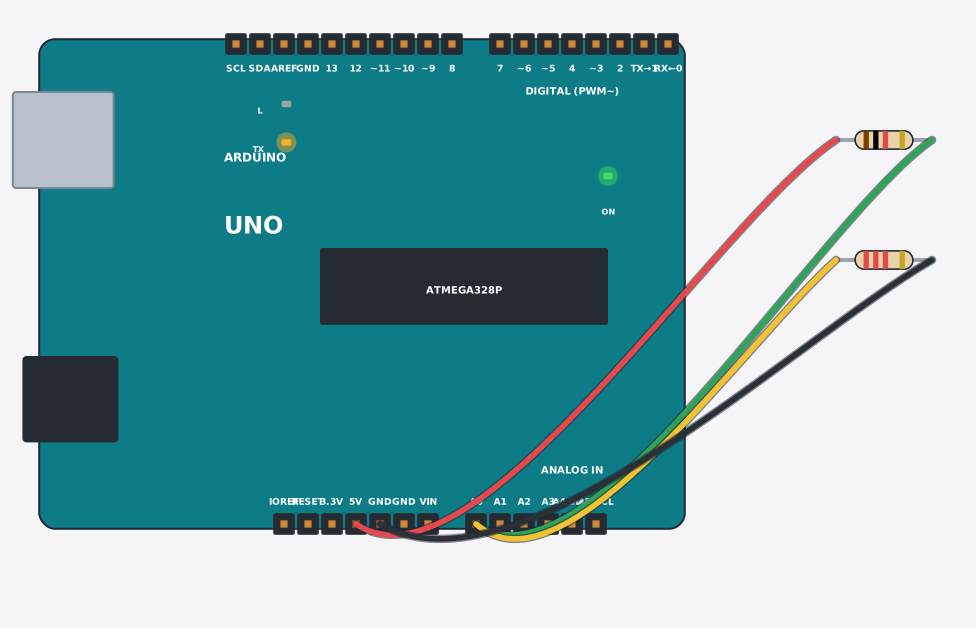
ওহমের সূত্র: V = I × R — voltage সমান current গুণ resistance। এখানে 1 kΩ আর 2.2 kΩ পরপর লাগানো, দুজনে মিলে 5 V ভাগ করে নেয়: I = 5 V ÷ 3.2 kΩ ≈ 1.56 mA। R2 পায় 2.2 kΩ × 1.56 mA ≈ 3.44 V — এই ভাগাভাগিই voltage divider। Resistor এর মান বদলাও আর Serial Monitor এ সংখ্যা দেখো।
Ohm's law says V = I × R: voltage equals current times resistance. Here 1 kΩ and 2.2 kΩ in series share 5 V, so I = 5 V ÷ 3.2 kΩ ≈ 1.56 mA. R2 gets 2.2 kΩ × 1.56 mA ≈ 3.44 V — that split is a voltage divider. Change a resistor's value and watch the numbers on the Serial Monitor.
সার্কিট ডায়াগ্রাম · Circuit diagram
যা যা লাগবে · Parts you need
- 1 × Arduino Uno Arduino Uno
- 1 × Resistor 1000Ω Resistor
- 1 × Resistor 2200Ω Resistor
- 4 × Jumper wires জাম্পার তার
তার লাগানো · Wiring
| Arduino Uno 5V | → | Resistor a |
| Resistor b | → | Arduino Uno A0 |
| Arduino Uno A0 | → | Resistor a |
| Resistor b | → | Arduino Uno GND |
Code (Arduino C++)
// Ohm's law: V = I x R.  Two resistors in series share the 5 V (a voltage divider).
// The Arduino measures the voltage across R2 on A0 and works out everything else.
const float R1 = 1000.0;   // ohms - top resistor
const float R2 = 2200.0;   // ohms - bottom resistor (change these if you change the parts)

void setup() {
  Serial.begin(9600);
}

void loop() {
  float v2 = analogRead(A0) * 5.0 / 1023.0;  // voltage across R2
  float v1 = 5.0 - v2;                        // the rest is across R1
  float current = v2 / R2;                    // Ohm's law: I = V / R
  Serial.print("V across R1 = "); Serial.print(v1); Serial.println(" V");
  Serial.print("V across R2 = "); Serial.print(v2); Serial.println(" V");
  Serial.print("Current I = "); Serial.print(current * 1000.0); Serial.println(" mA");
  Serial.print("Check: R1 = V1 / I = "); Serial.print(v1 / current); Serial.println(" ohm");
  Serial.println();
  delay(2000);
}