Diode
1N4007 Diode
৳6
- Fresh, latest-batch stock — never old shelf stock
- Tested before it ships
- Arrives dead? We replace it
- Same-day delivery in Dhaka · Cash on Delivery nationwide
- See it before you buy: visit our shop at Ansar Ali Sarak, Boat Ghat, East Nurer Chala, Vatara
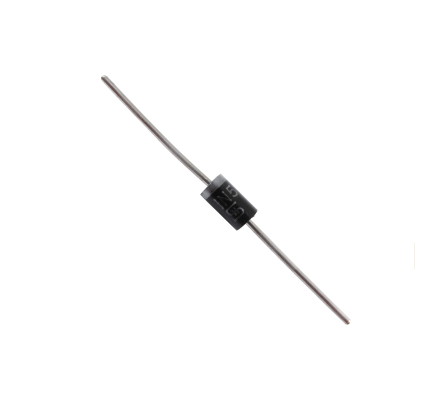
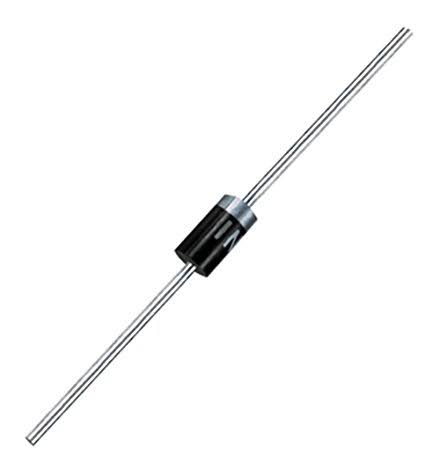
The 1N4007 Diode is the standard general-purpose rectifier: 1 amp of forward current and a 1000 V reverse rating in a DO-41 axial body with the cathode marked by a band.
It rectifies mains and transformer AC in bridge and half-wave supplies, blocks a reversed battery from damaging a circuit, and clamps the flyback spike of relays, solenoids and small motors. Every rectifier lab burns through a handful, and repair benches keep a strip of them in the drawer.
- 1 A average forward current, 1000 V reverse voltage
- Forward drop up to about 1.1 V at 1 A, so not the pick for low-voltage battery rails
- Survives roughly 30 A non-repetitive surge while filter capacitors charge
- Standard recovery: right for 50 Hz rectification, wrong for fast switching supplies
Above 1 A, step up to the 1N5408 (3 A) or the 6A10 (6 A); where every tenth of a volt matters on a battery path, the Schottky 1N5819 drops about half the voltage.
Not sure it will work? Test your circuit free in Tekko Sim — on your phone, in Bangla or English.
| Category | Diode |
| Model no. | 1N4007 |
| Availability | In stock |
| In stock | 18 pcs |
| Delivery | Cash on Delivery, nationwide Bangladesh |
| Device | 1N4007 general purpose rectifier diode |
| Configuration | single axial diode |
| Average Forward Current | 1 A |
| Repetitive Reverse Voltage (VRRM) | 1000 V |
| Forward Voltage (VF) | approx. 1.1 V max at 1 A |
| Non-repetitive Surge Current | approx. 30 A |
| Recovery Type | standard recovery, for mains and audio frequencies |
| Package | DO-41 axial, cathode marked with band |
| Operating Temperature | approx. -65 to +175 °C junction |
| Typical Uses | bridge rectifiers, polarity protection, relay flyback damping, chargers |
Customer reviews
No reviews yet — be the first.
Questions about the 1N4007 Diode
What does a 1N4007 diode do?
It lets current pass in one direction only, so it rectifies AC into DC, protects circuits from reversed batteries and absorbs the reverse voltage spike that coils and motors produce when switched off.
Which end is positive on a 1N4007?
The band marks the cathode. Current enters the unbanded anode and exits the banded cathode; in a rectifier output the banded side sits on the positive DC rail.
How do I use it for reverse polarity protection?
Place it in series with the supply input so wrong polarity simply blocks current, or wire it in reverse across the supply rails as a crowbar that blows the fuse if someone swaps the terminals.
Why put a 1N4007 across a relay coil?
A coil stores energy and releases a high-voltage spike when the driving transistor turns off; the diode short-circuits that spike in reverse, protecting the transistor and preventing contact arcing.
Can it handle my 5 amp power supply?
Not alone. Four 1N4007 diodes as a bridge are good only up to 1 A of DC; step up to 3 A rectifiers like the 1N5408 or 6 A parts like the 6A10 for multi-amp outputs.
Is it suitable for switching power supplies?
No. Its slow standard recovery suits 50 Hz mains work; at tens of kilohertz you need fast-recovery or Schottky diodes such as the UF4007 or 1N5819.
More in Diode
All diode →