Resistor Color Code: Read Any Resistor in Seconds
How to read the resistor color code: what the four bands mean, which resistor an LED needs on 5V, and a value table for Tekko's 1/4W resistors.
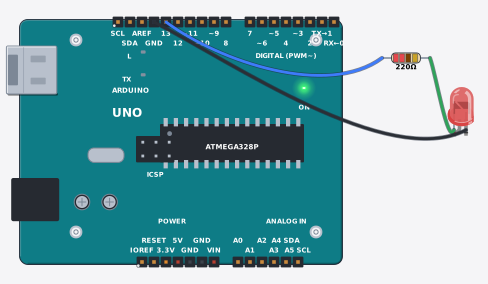
You have an LED on the breadboard and a handful of resistors with nothing on them but colored rings. The resistor color code is how you tell a 220 Ω from a 10 kΩ. A resistor is too small to print numbers on, so the value goes on as colors.
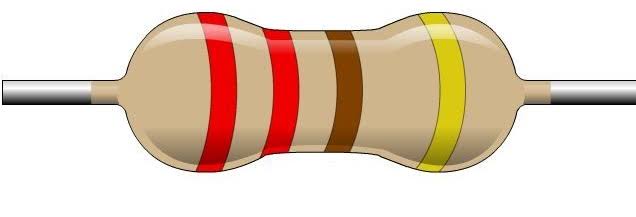
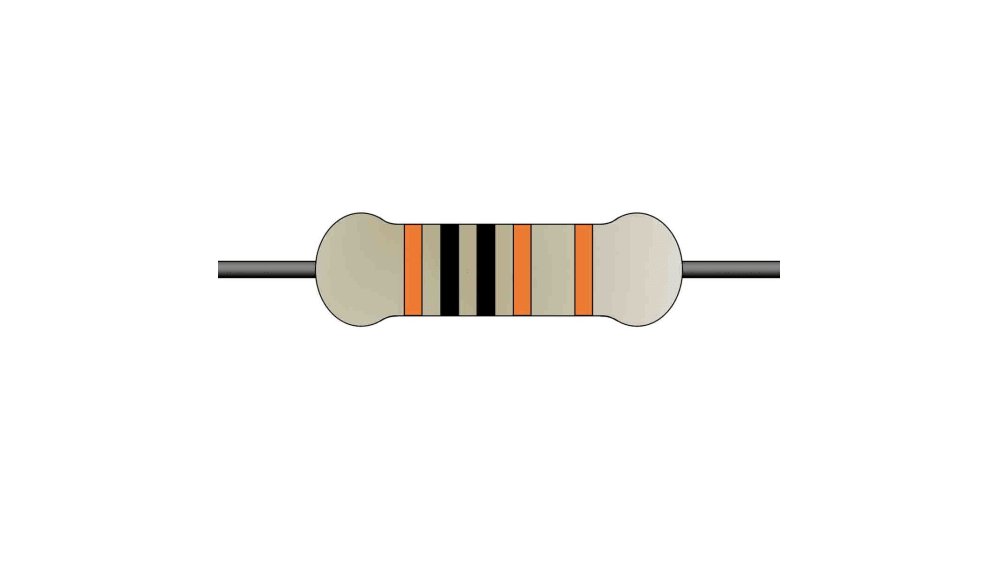
One rule covers it: the first two bands are digits, the third is the multiplier (how many zeros), the fourth is tolerance. Gold is almost always the last band. Hold the gold end on the right and read from the left.
What you need
- A handful of resistors (1/4W film is fine)
- A multimeter, if you have one, to check your reading
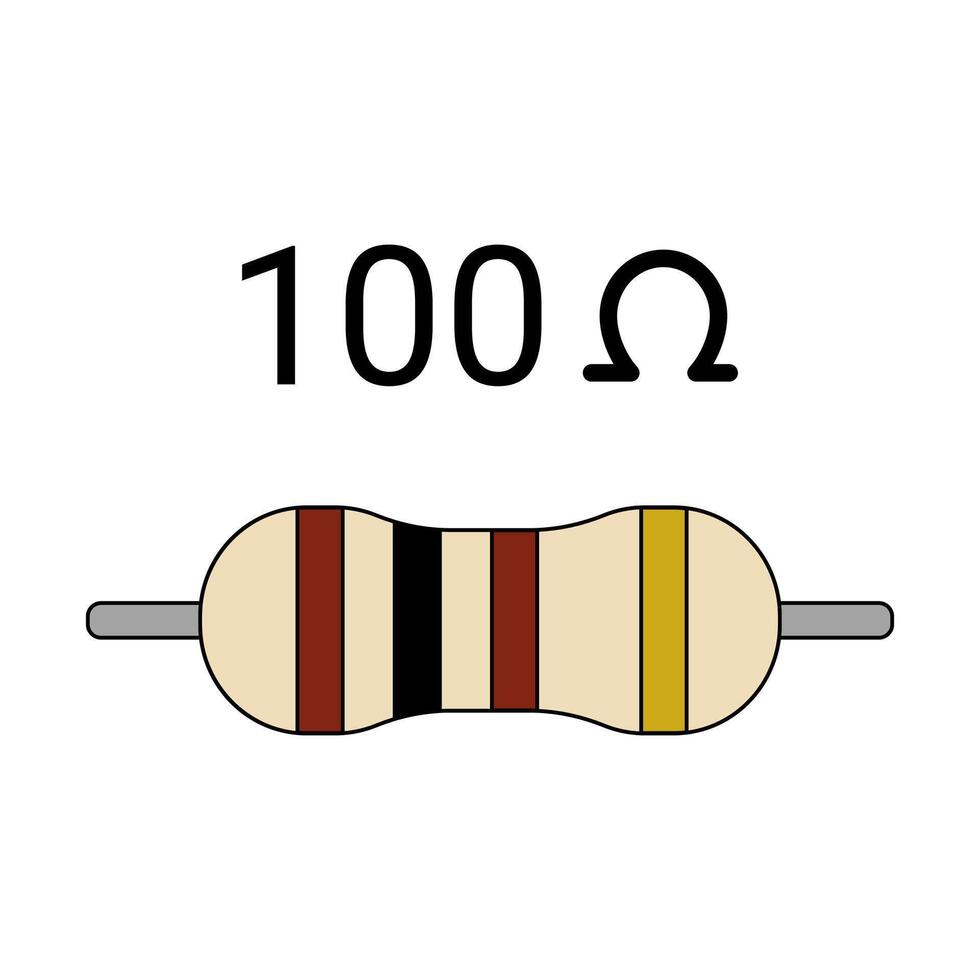
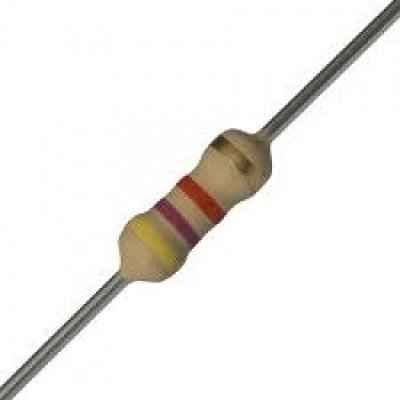
Prices can change; check Tekko for the latest.
Resistor color code: color = digit
| Color | Value |
|---|---|
| Black | 0 |
| Brown | 1 |
| Red | 2 |
| Orange | 3 |
| Yellow | 4 |
| Green | 5 |
| Blue | 6 |
| Violet | 7 |
| Grey | 8 |
| White | 9 |
Tolerance band: gold = ±5%, red = ±2%, brown = ±1%. The 1/4W film resistors you buy in a shop are normally gold.
Worked example: red–red–brown–gold
Red = 2, red = 2, brown = ×10 (one zero). That is 220 Ω, the usual resistor for an LED on an Arduino.
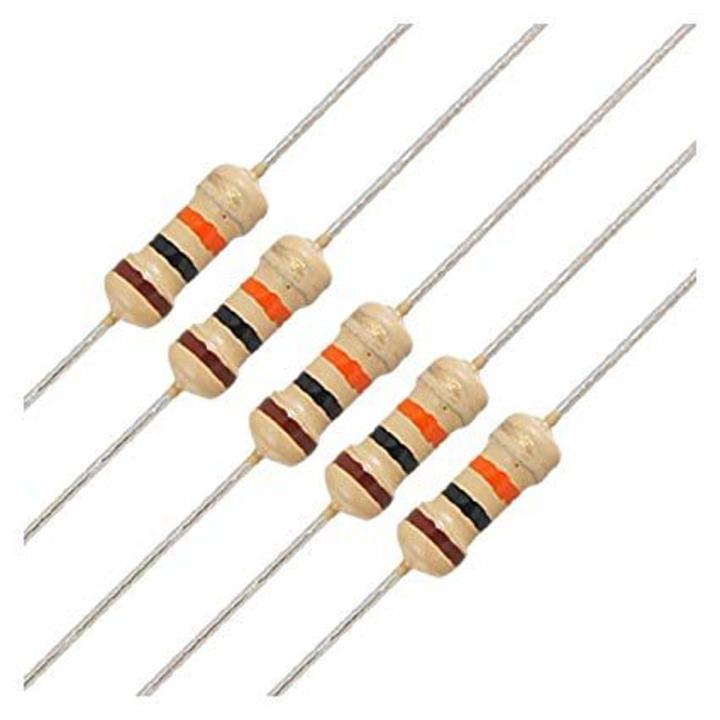
Another: brown–black–orange–gold = 1, 0, ×1000 = 10 kΩ. Orange adds three zeros, yellow adds four. Each step up in the multiplier color is one more zero.
Which resistor for an LED
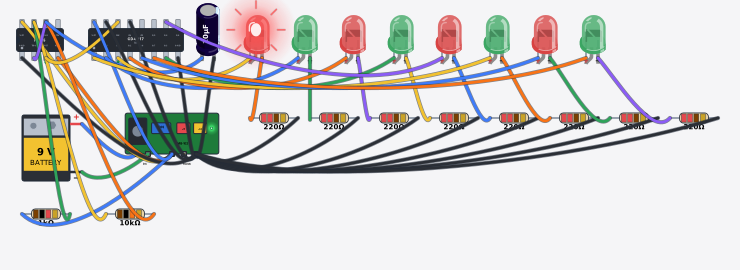
A common red LED drops ≈2V and is happy at ≈15 mA. On 5V: R = (5−2) ÷ 0.015 ≈ 200 Ω, and the nearest standard value is 220 Ω. Blue or white LEDs (≈3V) take 150–220 Ω.
Skip the resistor and the LED is very bright for a moment, then it is dead.
Tip
Measure after you read. On the Ω range, a reading within ±5% of your decoded value means you decoded it right. Do two or three a day and it sticks within a week.
Tekko's 1/4W values in one table
| Value | Code (4-band) | Typical use |
|---|---|---|
| 10 Ω | brown–black–black | small current limiting |
| 47 Ω | yellow–violet–black | LED on a low-voltage supply (not 5V) |
| 100 Ω | brown–black–brown | LEDs, transistor base |
| 220 Ω | red–red–brown | the usual Arduino + LED value |
| 330 Ω | orange–orange–brown | a slightly safer LED value |
| 470 Ω | yellow–violet–brown | LED, pull-down |
| 1 kΩ | brown–black–red | transistor base, pull-up |
| 1.5 kΩ | brown–green–red | I2C pull-up |
| 2.2 kΩ | red–red–red | transistor bias |
| 3.3 kΩ | orange–orange–red | filters, dividers |
| 4.7 kΩ | yellow–violet–red | DS18B20 pull-up |
| 10 kΩ | brown–black–orange | button pull-down, LDR divider |
| 20 kΩ | red–black–orange | high-impedance divider |
| 33 kΩ | orange–orange–orange | voltage divider |
| 47 kΩ | yellow–violet–orange | audio bias |
| 220 kΩ | red–red–yellow | timing circuits |
| 330 kΩ | orange–orange–yellow | timing circuits |
| 470 kΩ | yellow–violet–yellow | high-impedance divider |
Prices are on the resistors category page.
Watt rating: why a resistor gets hot
Warning
Do the sum before you wire: P = V² ÷ R. Put the full 5V across 100 Ω and P = 25 ÷ 100 = 0.25 W, which is exactly the limit of a 1/4W resistor, so it will run hot. If a resistor ever feels too hot to hold or turns dark, cut the power and swap in a higher value or a higher wattage.
Keep the formula: P = V × I = V² ÷ R. A 220 Ω resistor with an LED on 5V dissipates about 0.04 W, far under 0.25 W. Nothing to worry about there.
Verify it works
Decode any resistor by eye first, write the number down, then measure it. Within ±5% means you read it right. For a 1 kΩ that is anything from 950 to 1050 Ω.
Common problems
- Ten times off because you read it backwards. Find the gold band first, it goes on the right. With no gold, look for the band that sits a little further from the rest: that is usually tolerance, and it is the last one.
- Five bands instead of four. That is a precision resistor: three digits, then multiplier, then tolerance. Tekko's 1/4W film resistors are four-band.
- Red or orange? Hard to tell. Use better light or zoom in with your phone camera. If it is still unclear, measure it.
FAQ
Does resistor direction matter? No. It works the same either way round. Only the reading has a direction.
Why 220 Ω and not 200 Ω? Factories make standard E-series values (220, 330, 470, 1k, 10k and so on), and 220 is the one nearest 200.
What happens with 1 kΩ on an LED? It lights, but dim. Less current does no harm. More resistance is safe, less is not.
More from Tekko
- Resistors category
- Reading capacitor codes, the next thing to learn after this
- Try LED + resistor free: led-resistor in Tekko Sim
Sources
- Arduino Blink example — arduino.cc
Try it free before you buy
This project runs free in Tekko Sim, right in your browser — before you spend a taka.
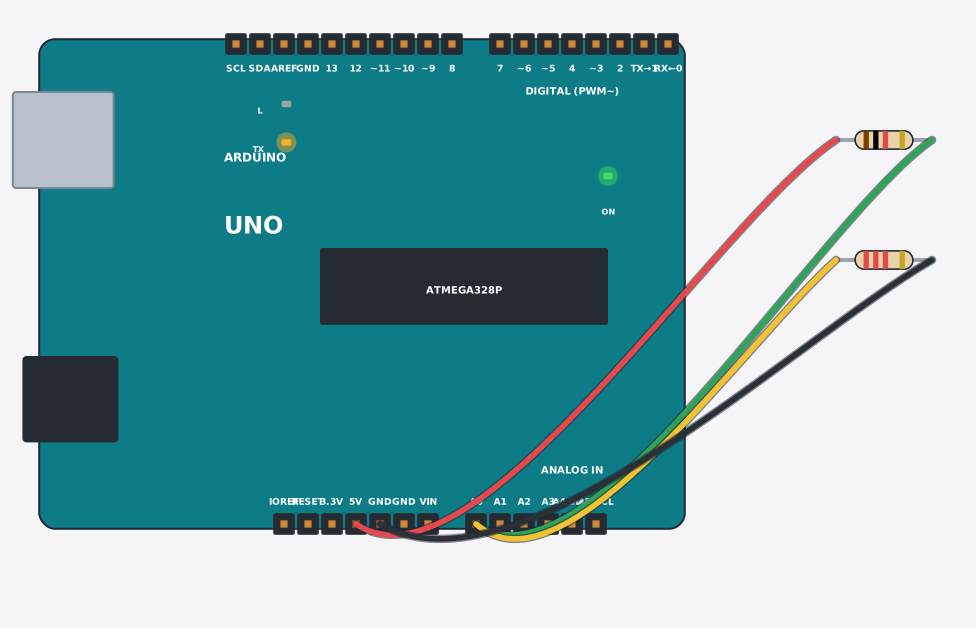
Arduino LED with Resistor (220Ω) — Run in Sim